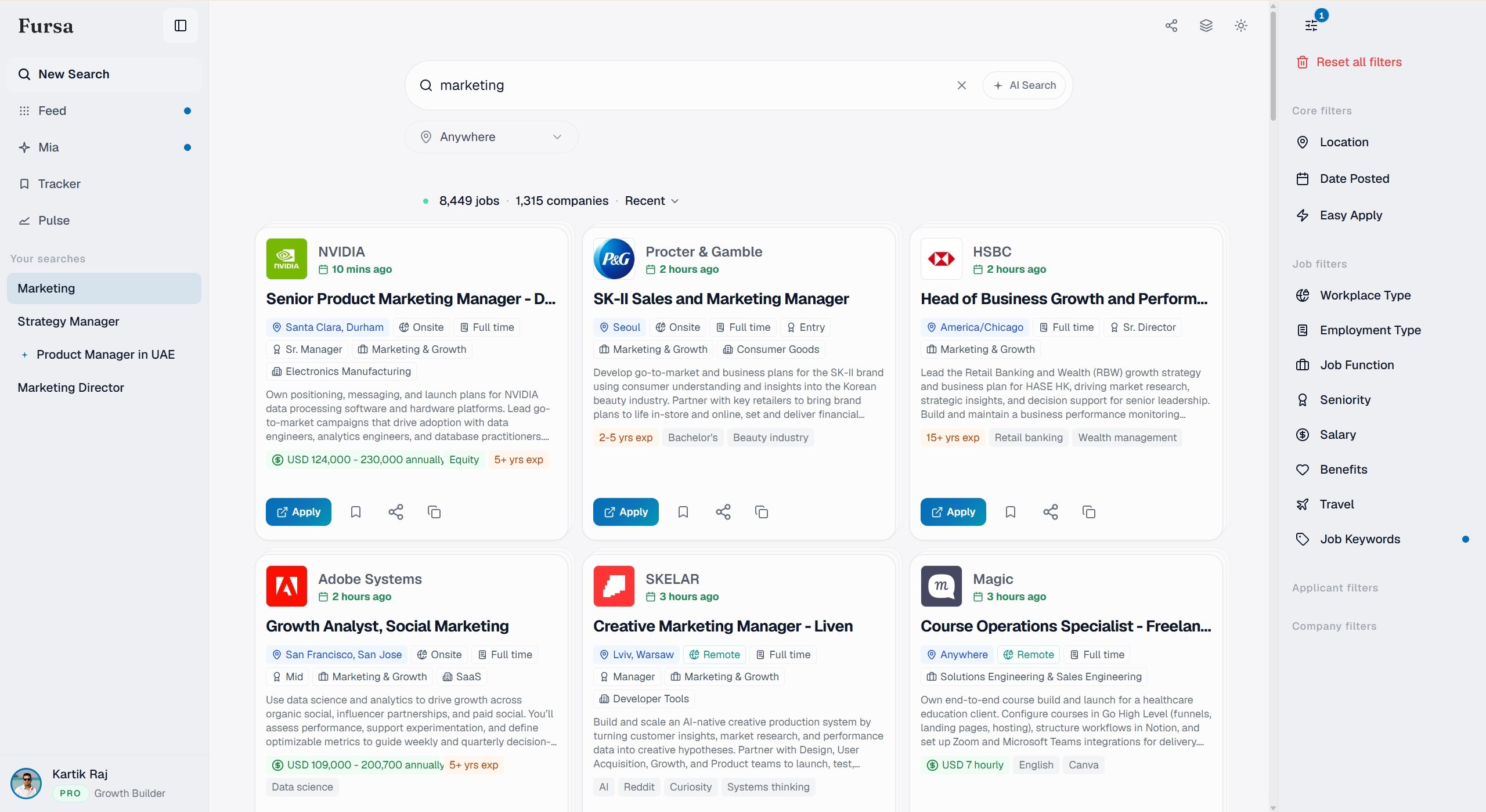
Fursa helps people find jobs published directly by employers. Every role comes from an employer source, is checked to confirm that it is still open, and shows when it was last verified. Candidates then apply through the employer’s official application route.
The name means “opportunity” in several languages. The story began in 2024 while helping friends and family look for jobs. The more we searched, the clearer it became that the market was not working particularly well for candidates. Many platforms are rewarded for showing more listings, generating more applications, and keeping people inside their ecosystems. They are not always rewarded for helping someone find the right opportunity while it is still available.
Over the past two years, I have been exploring better models for job search. The current version of Fursa took shape over the past ten months as a singular caffeine-induced effort, with a great deal of learning and rebuilding along the way.
What early users taught me
More than 5,000 people have used Fursa since mid-February. Their use and feedback gave me a much clearer picture of what users valued, what needed improvement, and where it fell short.
Those first five months validated two beliefs that shaped Fursa from the beginning.
First, people wanted to apply directly to employers. They did not want to submit their details to another intermediary without knowing where the application would go. They wanted to see the original role and apply through the employer’s official process. That remains a core principle.
Second, freshness mattered more than volume. A search engine can show hundreds of thousands of jobs and still be unhelpful if many are expired, duplicated, incorrectly categorized, or copied from somewhere else. That led to a simple standard: a role belongs on the platform only if it was published by the employer and remains open. Every listing shows when it was last checked.
Today, Fursa covers more than 3,000 companies, with a median refresh time of 12 hours. As I add more computing capacity, the index will be checked even more frequently.
The deepest coverage is currently in the UAE. The number of companies and jobs covered across Saudi Arabia, the United States, Canada, and other markets is also expanding rapidly. Wherever the index grows, the same standard applies: jobs must come directly from employers and remain actively verified.
Fewer jobs, better results
Along the way, I removed aggregators, mass recruiters, recruitment agencies, bulk staffing companies, and other sources that made the results noisier without making them more useful.
The refresh frequency also doubled. These decisions reduce the number of jobs the platform can claim to have, and I am comfortable with that. The goal is not to display the biggest number on a homepage. It is to help someone find a relevant opportunity that is genuinely available.
There will still be mistakes. A role may close shortly after it is checked, or a job may be categorized incorrectly. The systems that find, verify, structure, and refresh jobs will keep improving, and sources that do not meet the standard will continue to be removed.
To be honest, the early version also exposed problems outside the core experience. The site’s SEO and analytics were not working properly, which made it harder to discover and harder for me to understand how it was being used. A significant amount of work has now gone into rebuilding both.
More useful ways to search
Traditional job search usually begins with a title and a location. Real career decisions are more complicated.
Someone may be looking for a strategy role at a growing technology company, be open to several countries, and care about remote work, company stage, seniority, salary, industry, or a particular career transition.
Candidates can search using natural language, upload a resume, speak their search aloud, or chat with Mia, an AI recruiter built into Fursa. These became some of the most popular experiences among early users and are now a much larger focus.
The personalized Feed is designed for people who are not actively looking for a job today. It acts as an always-on career radar, surfacing relevant opportunities as they appear so candidates can stay informed without repeatedly running the same searches.
Some of the simplest features were also among the most popular. Users liked being able to group results by company so that no single employer crowded the search page, then ungroup them whenever they wanted a traditional list. The three visual themes, Light, Dark, and Midnight, were another unexpected hit.
The core search experience remains free. Candidates can search, open jobs, and apply through the official employer process without paying. Fursa Pro adds the more advanced tools described above, along with instant alerts and cloud-synced saved searches. Every new user receives one week free.
Several startups told me that existing applicant-tracking systems were too complex or expensive for their basic needs. They wanted a simpler way to publish jobs, manage applicants, and reach relevant candidates.
Fursa now includes a free, lightweight applicant-tracking system for startups that do not have a suitable solution. Access is limited while it is tested with a small number of employers. Jobs published through it flow directly into the index, giving candidates access to more current opportunities from hiring teams.
This work is still early. The goal is to help employers find relevant candidates without creating more noise for either side of the market.
Live, but not finished
Launching today does not mean the product is complete. There are still bugs to fix, companies to add, coverage to expand, recommendations to refine, and new features to build. Some searches will be stronger than others, and many roles are not covered yet.
Some of what comes next is already taking shape: optional video profiles and introductions to hiring managers when there is a genuinely strong match, even if you are not actively looking. Your identity would remain private unless you choose to share it. These features are still being built, but I am excited by what they could unlock.
The next stage is turning this one-person effort into an AI-native hiring company. Toward the end of the year, I plan to begin hiring across data, product, growth, and operations as the company moves into the next stage of its vision.
The standard remains simple: help people find the right opportunities while they are still open.
Visit fursa.io/search and search for the role you would genuinely want next. If the results are not good enough, tell me why at [email protected].